The regular Lebanese military isn't there to fight Israel. If you don't grasp that fundamental truth, the latest news out of southern Lebanon won't make a lick of sense.
On Saturday, June 13, 2026, the Lebanese army packed up its gear and abandoned its barracks in the southern village of Kfar Tebnit. They pulled back because Israeli ground forces were pushing hard into the immediate area. For a casual observer, it looks like a military retreat in the face of an enemy advance. But looking at it that way completely misinterprets what the Lebanese Armed Forces (LAF) actually do in the south.
The LAF isn't the primary combatant hitting Israeli tanks. That role belongs to Hezbollah, the heavily armed, Iranian-backed faction that operates independently of the Beirut government. When Israeli armor rolls across the border, the official Lebanese army gets out of the way. It's a calculated survival mechanism for a state institution caught between an overwhelming foreign military and a powerful domestic militia.
The Push for Ali Taher Hill
The tactical reason for the sudden pullback centers on a specific piece of high ground on the edge of Kfar Tebnit. Israeli troops are making a concentrated push to secure the strategic Ali Taher hill.
Geography tells you everything you need to know about why this hill is prized. It directly overlooks major portions of Nabatiyeh, a critical southern city, and commands the primary transit routes linking Nabatiyeh to its surrounding villages. If you control Ali Taher hill, you effectively control the logistics and movement of the entire sector.
This isn't new territory for the Israeli military. They held the exact same hill for 18 years during their previous occupation of southern Lebanon, only relinquishing it when they withdrew in May 2000. By pushing back toward Kfar Tebnit and Ali Taher, the Israeli military is reclaiming historical vantage points. It follows an aggressive campaign in late May, when Israeli forces seized the nearby strategic mountain topped by the Crusader-built Beaufort Castle, marking their deepest ground incursion into Lebanon since the turn of the century.
Land Grabs Ahead of a Potential Ceasefire
Why is this escalation happening right now? The timing isn't accidental. It's a classic military scramble to secure maximum leverage before diplomatic windows slam shut.
Just a day prior to the assault on Kfar Tebnit, diplomatic circles began buzzing with news of a breakthrough. Pakistan's prime minister announced that the United States and Iran had finally agreed on the core wording of a comprehensive agreement to end their wider regional war. Iranian Foreign Minister Abbas Araghchi confirmed on state television that both sides are actively working toward an initial agreement to declare an end to hostilities on all fronts. Crucially, senior Hezbollah officials have stated they've been informed by Tehran that Lebanon will be included in this overarching ceasefire package.
When armies smell a diplomatic resolution on the horizon, they don't stop fighting. They push harder. Israel's current military strategy appears to be a rapid land grab to establish facts on the ground. By capturing dominant geographical features like Ali Taher hill and Beaufort Castle, Israel places itself in a far stronger position to dictate terms, enforce buffer zones, and ensure security guarantees once a formal pen hits the paper.
The Heavy Price of a Nominal Ceasefire
To understand how chaotic this environment is, you have to realize that Lebanon is technically already under a ceasefire. An agreement went into effect back on April 17 and has been extended several times.
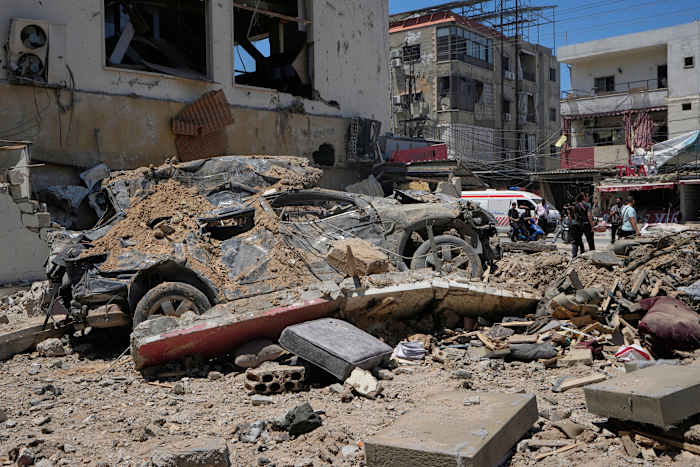
In reality, it's a ceasefire in name only. The fundamental flaw is that Hezbollah was never a direct party to the bilateral truce between the official governments of Israel and Lebanon. Because Hezbollah operates outside state control, its fighters have kept up a steady stream of rocket and fiber-optic drone attacks. In response, Israel continues to occupy massive swaths of southern Lebanese territory, hammering the region with artillery and airstrikes.
The human and material toll of this conflict has grown staggering. According to the Lebanese Health Ministry, more than 3,700 people have been killed in Lebanon since the broader Israel-Hezbollah war ignited on March 2. On the other side, Israeli Prime Minister Benjamin Netanyahu’s office reports that 30 Israeli soldiers, a defense contractor, and two civilians in northern Israel have lost their lives in the fighting.
Even the retreating Lebanese soldiers aren't safe from the crossfire. Hours after the pullback from the Kfar Tebnit barracks, an Israeli drone targeted a Lebanese soldier traveling near a hospital in Nabatiyeh. While that initial strike missed, a second drone successfully struck the same soldier on the road to Kfar Rumman, leaving him seriously wounded. It's a grim reminder that in a modern combat zone thick with loitering munitions, absolute neutrality doesn't guarantee your safety.
What Happens Next
If you're tracking the security situation in the Middle East, don't watch the official political speeches in Beirut. Watch the high ground around Nabatiyeh. The withdrawal from Kfar Tebnit is a clear signal that local territorial dynamics are shifting rapidly before diplomacy freezes the front lines.
- Monitor the diplomatic track: Keep a close eye on the finalization of the U.S.-Iran negotiations. The details of that specific text will dictate whether the current Israeli advances turn into a long-term occupation or a temporary bargaining chip.
- Track the drone warfare evolution: Pay attention to Hezbollah’s increasing reliance on fiber-optic drones. These weapons don't rely on radio frequencies, making them immune to standard electronic jamming. They're actively changing tactical calculations on the ridgelines of southern Lebanon.
- Watch the pilot zones: Watch whether the concept of "pilot zones"—where the Lebanese army is supposed to take exclusive territorial control while excluding non-state actors—can actually survive when the state military lacks the hardware and political backing to stand its ground against either Israel or Hezbollah.