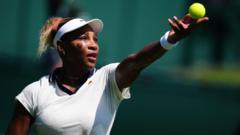
Serena Williams is officially returning to singles tennis at Wimbledon, and the sports world is completely losing its mind. The draw dropped today, shaking up the entire tournament structure. At 44 years old, the seven-time Wimbledon singles champion is stepping back onto the grass of SW19. Her opponent is 20-year-old Australian Maya Joint, a player who wasn't even born when Williams secured her first Grand Slam trophy back in 1999.
This isn't a ceremonial exhibition appearance. It is a full-blown competitive return. Williams accepted a late singles wildcard from the All England Club, sending shockwaves through the locker room. She has not played a professional singles match since falling to Ajla Tomljanovic at the 2022 US Open, an emotional night that everyone assumed was her definitive farewell.
Instead of staying retired, Williams decided she had unfinished business. For tennis fans trying to make sense of this sudden comeback, the first-round matchup presents an absolute fascinating collision of generations, styles, and psychological pressure.
The Truth About Serena's 2026 Comeback
When Williams stepped away from the sport four years ago, she intentionally avoided using the word retirement. She preferred saying she was "evolving away" from tennis to focus on her family and business ventures. Her second daughter was born in 2023, and life outside the tour seemed settled.
What changed? According to reports close to her camp, the primary motivation stems from a deeply personal desire. She wants her young daughters to witness her competing on the greatest stage in tennis while they are old enough to retain the memory. That kind of emotional fuel can make an athlete incredibly dangerous, but it doesn't automatically erase four years of competitive rust.
Singles tennis is brutal on the body, especially at 44. To prepare, Williams dipped her toes back into competition earlier this month by entering doubles events. She paired up with young Canadian Victoria Mboko at the Queen's Club Championship, winning their opening match before an injury to Mboko cut their run short. Last week, Williams took the court in Berlin alongside Czech star Karolina Muchova, where they lost a tight two-set battle to Erin Routliffe and Giuliana Olmos.
Those doubles matches showed that Williams still possesses her trademark power, but moving efficiently across a grass court by yourself is an entirely different challenge. The lack of lateral movement tracking and match-tempo endurance will be her biggest hurdles. She hasn't won a singles match at Wimbledon since reaching the final in 2019. Her last appearance in 2022 ended immediately in the first round with a heartbreaking, physical defeat against Harmony Tan.
Who is Maya Joint and Why is She Slumping
On paper, drawing a 20-year-old ranked 53rd in the world might sound like a tough task for a rusty legend. But if you look closer at the actual numbers, Maya Joint is entering this tournament under an immense cloud of stress.
Joint had a meteoric rise through the ranks over the past two seasons. Born in Michigan but representing Australia, she cracked the top 30 early in 2026, reaching a career-high ranking of world number 28. She plays an aggressive game from the baseline, which helped her secure WTA titles on both clay in Rabat and grass in Eastbourne during her breakthrough year.
Right now, Joint is experiencing the classic sophomore slump, and it is hitting her hard.
She has lost 13 of her last 14 competitive matches. Her season has basically unraveled over the past few months, resulting in 10 first-round exits in her last 11 tournaments. Her confidence looks completely shattered on court. When you are struggling to find your rhythm, the last person you want to see across the net on a packed Center Court is Serena Williams.
Joint possesses solid baseline metrics when she is playing well. She converts roughly 48% of her break point opportunities and is highly effective at attacking second serves. Her glaring weakness is her own defensive service game. She averages a mere 0.15 aces per game and only wins about 45% of her second serve points. If her first serve percentage drops on Tuesday, Williams will feast on those soft second serves.
Tactical Breakdown of the Matchup
This match won't be decided by lengthy 20-stroke rallies. Grass-court tennis inherently favors short, explosive points, which heavily benefits Williams.
The strategy for Williams is simple: hold serve at all costs and shorten the points. Her serve remains arguably the greatest weapon in the history of women's tennis. Even with reduced shoulder speed, her placement, disguise, and natural spin are nightmare adjustments for someone who has never faced it. If Williams can keep her first-serve percentage above 60%, she will win cheap points and avoid exhausting baseline exchanges.
For Joint, the path to victory requires making Williams run. Joint has to use her youth and speed to extend matches. If she can survive the initial barrage of power in the first four shots of a rally, the physical advantage shifts heavily in her favor. Joint needs to use deep, biting slices to keep the ball low to the grass, forcing the 44-year-old Williams to bend her knees constantly and hit on the stretch.
The biggest variable is the psychological weight of the occasion. Center Court during a Serena Williams comeback match is an intimidating, loud theater. Joint has never experienced that specific brand of pressure. If the crowd gets involved early, it could easily accelerate Joint's current slide.
The Gauntlet Awaiting the Winner
If Williams manages to navigate past Joint, nobody is giving her an easy ride through the tournament. The bottom half of the 2026 Wimbledon draw is incredibly top-heavy.
A victory on Tuesday would advance Williams to the second round, where she would face either the 29th seed, Filipino rising star Alexandra Eala, or Mexico’s Renata Zarazua. Eala is a stellar young talent with exceptional court coverage who would provide a massive physical test for Williams.
Should she survive that second-round match, the reward is a potential third-round blockbuster against the reigning Wimbledon champion and world number three, Iga Swiatek. Swiatek is starting her title defense on Tuesday against American Taylor Townsend. A Williams vs. Swiatek match on grass would be an instant classic, though the physical reality favors the current champion significantly.
Further up the line, the projected quarterfinals based on tournament seedings look stacked. Number 1 seed Aryna Sabalenka is on a collision course to meet French Open winner Mirra Andreeva, while number 2 seed Elena Rybakina could potentially face 2025 runner-up Amanda Anisimova. Williams is sitting deep in a section of the draw that requires absolute perfection to survive.
Double Trouble with Sister Venus
The singles run isn't the only story. In another nostalgic twist, Serena will also pull double duty by playing the ladies' doubles tournament alongside her older sister, Venus Williams. Venus turned 46 last week and has been playing a highly limited schedule herself.
Playing both events seems risky given the physical toll, but the Williams sisters have always treated doubles as a way to find their rhythm and timing for singles. It gives Serena extra time on the match courts to adjust to the specific low bounces of the grass without the intense baseline running required in singles.
How to Prepare and Watch the Match
The match is scheduled for Tuesday, June 30, 2026. If you want to follow this historic sports moment properly, do these things ahead of time to get the full context:
- Check the official Wimbledon order of play on Monday evening to secure the exact match time, as Center Court programming starts at 1:30 PM local time.
- Review Joint’s previous matches from her Eastbourne run last year to understand her natural movement on grass before she started her recent losing streak.
- Watch the opening games closely to see Serena's footwork. If she is adjusting her feet quickly to the low bounces in the first three games, she will likely win the match in straight sets.
- Monitor serve speeds on the television broadcast metrics. If Serena is hitting her first serves above 110 mph consistently, Joint will struggle to get returns deep into the court.