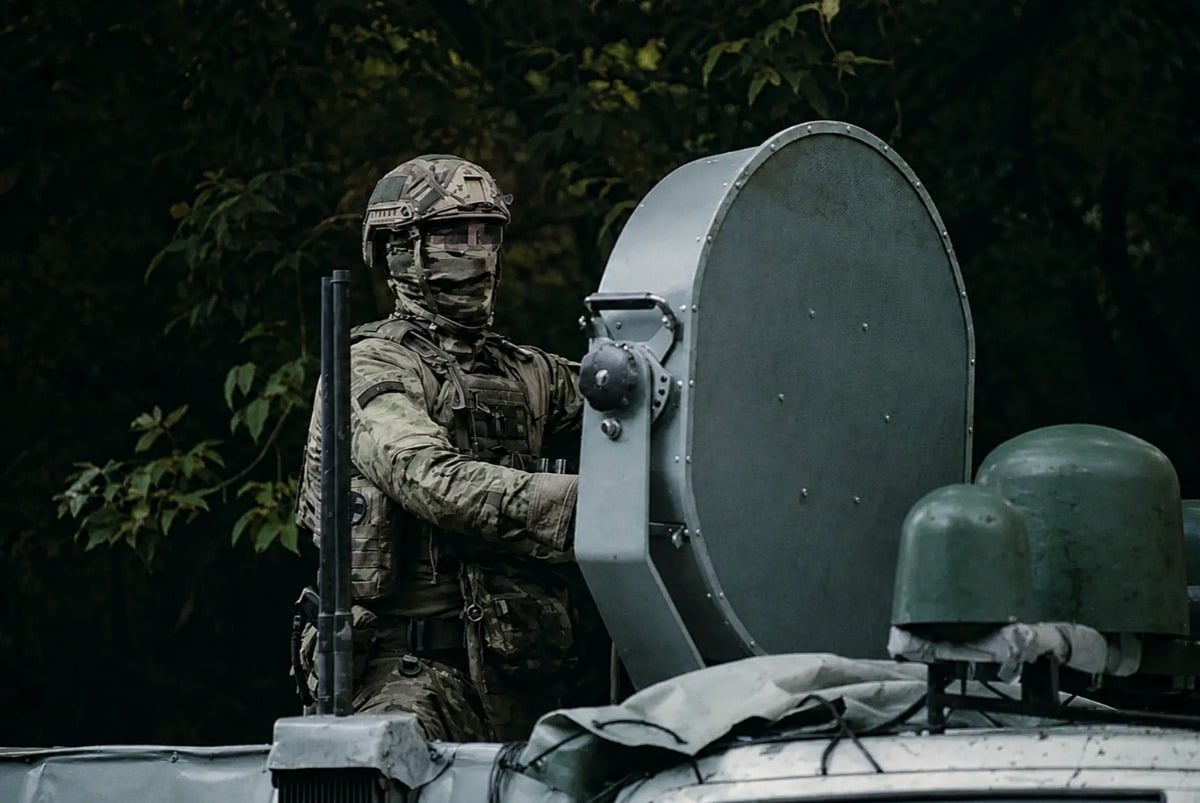
Radars are failing on the modern battlefield, and everyone in the defense community knows it. They act like giant electronic flashlights, shouting their position to any enemy missile or drone equipped with a radiation-seeking sensor. That's exactly why Ukrainian special operations forces and elite mobile air defense units are pivoting hard toward something that doesn't emit a single bleep.
Recent leaked photographs and military dispatches reveal that Ukraine's top tier operators are undergoing intensive field training with advanced, large format acoustic systems. Instead of looking for threats, they're listening for them. It's a strategy born from brutal necessity. The massive saturation of low flying cruise missiles, Iranian designed Shahed suicide drones, and first person view attack quadcopters has created blind spots that traditional Western defense tech simply wasn't built to handle.
The Sound Shield That Outsmarts Electronic Warfare
If you think acoustic monitoring sounds like a step backward to World War I style concrete listening dishes, you're missing the massive technological leap happening right now. The infrastructure relies on networks like Sky Fortress, Zvook, and FENEK. These aren't just microphones taped to sticks. They are highly sophisticated sensor nodes that use machine learning to process audio directly at the edge.
Traditional military radars scan the skies by blasting radio waves. When those waves hit an object, they bounce back. But that makes the radar station a massive target. Russian anti radiation missiles lock onto those signals instantly. Acoustic sensing completely eliminates this threat because it is entirely passive. It just sits there and listens. You can't jam a microphone with standard electronic warfare frequencies, and you can't blow it up with an anti radiation missile because there's no emission to track.
For elite troops operating behind enemy lines or protecting critical infrastructure in rear areas, this invisibility is everything. The system detects the unmistakable lawnmower hum of a Shahed 136 or the specific high pitched whine of an FPV drone engine long before it's visible to the naked eye.
Inside the Tech Triangulating Targets in Seconds
The real magic happens in how these individual microphones talk to each other. A single sensor can give you a rough direction, but a distributed mesh network changes everything.
- Local Audio Capture: A compact node, often mounted on a cell tower, rooftop, or hidden tree line, picks up ambient sound.
- Edge Processing: Microcomputers running specialized neural networks instantly filter out birds, wind, passing civilian trucks, and farm animals. It isolates the specific sound signature of an incoming threat.
- Compressed Messaging: Instead of streaming heavy raw audio files that eat up bandwidth and expose communications, the node sends a tiny, encrypted packet of data. This packet contains a timestamp and the direction of the sound.
- Central Triangulation: The cloud or regional command center correlates these packets from multiple nodes. By calculating the microsecond differences in when the sound hit each microphone, the software calculates the target's exact altitude, speed, and flight path.
- Cuing the Kill: The precision tracking data gets pushed directly to tablets and iPads held by mobile fire groups or elite teams waiting in pickup trucks.
This entire sequence happens in less than two or three seconds. By the time a cruise missile passes a cluster of sensors, its interception point is already plotted.
Shifting the Financial Burden of Air Defense
Western military doctrine loves expensive solutions. Firing a million dollar Patriot interceptor or a hundreds of thousands of dollars NASAMS missile at a twenty thousand dollar fiberglass drone is financial suicide in a war of attrition. It doesn't scale.
The acoustic network turns that equation on its head. Each individual sensor node costs somewhere between four hundred and one thousand dollars to manufacture. They utilize commercially available components, sometimes even leveraging the core processors of repurposed smartphones. You can build, deploy, and maintain thousands of these acoustic units for a fraction of the cost of a single traditional radar array.
More importantly, it maximizes the effectiveness of dirt cheap kinetic options. When elite troops get exact tracking data on their tablets, they don't need automated missile batteries. They can use heavy machine guns, twin barreled anti aircraft cannon, or shoulder fired MANPADS to down the threat. Training reports indicate that mobile fire groups require very minimal instruction to effectively utilize this interface, achieving interception rates that have stunned foreign observers.
What Western Armies are Missing About This Shift
Military planners in the United States and NATO are watching these deployments with intense interest, but many are still failing to grasp the cultural shift required to implement it. Western defense procurement is plagued by years of testing, bureaucratic bloat, and a obsession with overly engineered platforms.
Ukraine's acoustic network succeeded because it bypassed that entire ecosystem. It was prototyped by software engineers and tech startups working directly with frontline soldiers. They fixed software glitches in real time based on actual combat feedback. For instance, early iterations of the Zvook project struggled with false positives, occasionally identifying the lowing of livestock as an engine. The engineers didn't wait for a three year budget cycle; they updated the database and patched the code within weeks.
Now, American units are starting to experiment with these techniques. Troops at training grounds across Europe are learning to ditch their total reliance on automated displays and start building muscle memory for what different drone motors sound like. Reconnaissance drones hover with a flatter, higher sound signature, while one way strike assets scream in fast and heavy.
Immediate Steps for Implementing Acoustic Defense Tactics
If you're managing security for sensitive facilities or developing modern tactical doctrine, you can't afford to ignore passive acoustic deployment.
- Ditch the Single Node Mindset: Acoustic defense only works as a distributed web. One high end microphone is useless. You need multiple low cost sensors placed systematically to ensure overlapping fields of listening.
- Prioritize Local Filtering: Do not attempt to stream raw data back to a central server. Your network will get bogged down or intercepted. Processing must happen at the node level so that only light direction data is transmitted.
- Integrate with Mobile Fire Teams: Tracking data is useless if it sits in a command bunker. It must go directly into the hands of the operators with the weapons, using simple, ruggedized commercial tablets.
The era of relying solely on massive, emitting radar installations is drawing to a close. As battlefield transparency increases and electronic warfare blankets conflict zones, survival belongs to the silent.
An analysis of Ukraine's Sky Fortress acoustic system provides a fascinating breakdown of how these decentralized sound networks are actively disrupting drone strategies on the ground.