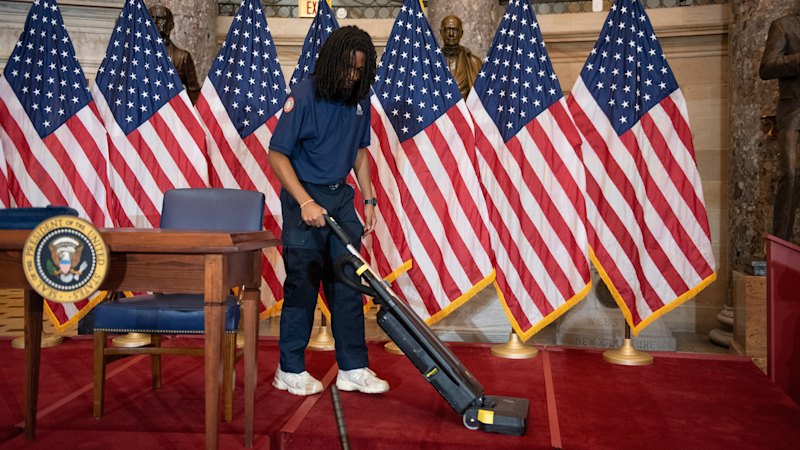
An empty stage sat in Statuary Hall on Wednesday, featuring a lonely signing desk stamped with the seal of the president. Minutes before, it was supposed to host a major political victory lap. Instead, the chairs stayed empty.
President Donald Trump abruptly canceled the high-profile signing ceremony for the 21st Century ROAD to Housing Act. The bipartisan bill was months in the making. It was designed to tackle skyrocketing housing costs. Yet Trump decided to hold the entire package hostage. His demand is simple but procedurally impossible. He wants the Senate to first pass the SAVE America Act, a strict voting measure requiring proof of citizenship and photo identification at the polls.
Trump took to social media to call the voting bill a national emergency. He dismissed the landmark housing legislation as minor compared to election security. This sudden pivot blindsided congressional leaders. It threw a wrench directly into the Republican party strategy just months before the critical 2026 midterm elections.
The Mathematical Wall in the Senate
This is not a dispute about the merits of voter ID. It is a dispute about basic math. Republicans hold a slim 53-47 majority in the Senate. Under current rules, most major legislation requires 60 votes to overcome a filibuster. Democrats are completely united against the SAVE America Act. They argue its documentation requirements would disenfranchise millions of eligible American voters who lack immediate access to birth certificates or passports.
Senate Majority Leader John Thune has spent weeks trying to explain this reality to the White House. The votes are simply not there. Thune even gave the voting bill significant floor time earlier this year to prove the point. It failed repeatedly.
When reporters asked Thune about Trump canceling the housing bill ceremony, the majority leader simply laughed. He later stated that lawmakers are bound by arithmetic. You cannot wish nine Democratic votes into existence.
Trump refuses to accept this logic. He has publicly demanded that Senate Republicans strip away the filibuster entirely. He wants them to pass the voting bill with a simple majority. But Thune does not have the internal party support to destroy the legislative filibuster either. Several institutionalist Republican senators refuse to take that step, knowing they could easily find themselves back in the minority in a future election cycle.
The strategy from the White House seems to rely entirely on public pressure. Trump traveled to the Capitol on Wednesday for a closed-door luncheon with Senate Republicans. It was his first visit to the conference in over a year. What was supposed to be a unity meeting quickly turned into a high-pressure lobbying session. Trump expects his colleagues to fight dirtier. He suggested attaching the voter ID requirements to must-pass spending bills or national security surveillance extensions.
Throwing Away an Election Year Lifeline
The timing of this legislative tantrum could not be worse for rank-and-file Republicans. Midterm elections are right around the corner. Voters consistently rank inflation, interest rates, and housing costs as their top anxieties.
The 21st Century ROAD to Housing Act was supposed to be the perfect shield against Democratic attacks. It was a genuine bipartisan compromise that featured 47 separate provisions to boost housing supply. The package included:
- Streamlined environmental reviews to fast-track affordable housing construction.
- Federal incentives for cities and states to loosen restrictive local zoning laws.
- Reforms making it cheaper to build and finance manufactured homes.
- A strict ban on massive institutional investors, like Blackstone, purchasing single-family homes.
That final provision banning corporate landlords was actually a specific demand from Trump himself during earlier negotiations. Senator Elizabeth Warren pushed for it on the Democratic side. It was a rare moment of alignment. House Speaker Mike Johnson was literally in the middle of a press conference praising the bill when Trump announced the cancellation online. Johnson had to quickly pivot, insisting to reporters that Trump would eventually sign the bill once he reviewed the fine print.
By ditching the ceremony, Trump handed Democrats an immediate messaging gift. Warren wasted no time going on television to claim Trump has a total indifference to the cost pressures facing ordinary families. For vulnerable Republicans running in swing states, losing the ability to brag about a major housing affordability victory is a massive unforced error.
A Twin Blow from the Federal Courts
Trump's sudden legislative escalation did not happen in a vacuum. It came the exact same day his administration suffered a massive legal defeat on the very same issue.
A federal judge permanently blocked the administration from enforcing its controversial executive order on elections. That executive action attempted to bypass Congress entirely by forcing states to demand documentary proof of citizenship during voter registration. The ruling from the court was decisive. The judge barred federal agencies from adding citizenship paperwork requirements to standard registration forms and stopped the Department of Defense from enforcing similar mandates on military personnel.
New York Attorney General Letitia James praised the court decision, calling the administration's efforts an unconstitutional attempt to seize control over state-run elections.
This legal wall explains why the White House shifted its focus so aggressively toward Capitol Hill. Because the courts keep striking down Trump's executive decrees on voting rules, he is trying to use the housing bill as leverage to force a legislative fix. If he cannot get voter ID through administrative orders, he will squeeze his own party until they break the rules of the Senate to give it to him.
Deepening Fissures and Primary Retribution
The tension on Capitol Hill exposes a much larger civil war over who controls the party platform heading into the midterms. Traditional lawmakers want to focus on governance, passing appropriations bills, and demonstrating economic competence. Trump wants the campaign to center on election integrity, immigration, and cultural battles.
The internal resentment is boiling over. Senator Mike Lee has backed Trump's hardline approach, warning on social media that Republicans face an electoral nightmare if they do not pass the SAVE America Act immediately. But his colleagues are getting tired of the rhetoric. During a private lunch last week, several Republican senators confronted Lee directly. They accused him of creating completely unrealistic expectations among conservative voters and dividing the party over a strategy that is mathematically dead on arrival.
Trump has also actively weakened his own support structure in the Senate. He heavily backed primary challengers against two sitting Republican incumbents, John Cornyn of Texas and Bill Cassidy of Louisiana. Both men were mainstream conservative votes who occasionally broke with the White House on institutional norms. Both lost their primaries to Trump-endorsed challengers.
While that solidified Trump's grip on the base, it deeply angered the remaining Senate establishment. Lawmakers look around and see colleagues being punished for doing the actual work of legislating. Cornyn openly warned that the party is not on the same page, calling the current division dangerous for their midterm prospects.
What Happens to the Housing Bill Now
Despite the high drama of the canceled press conference, the housing bill is not completely dead. Under the United States Constitution, a president has 10 days to sign or veto a bill once it lands on their desk. If they do nothing, and Congress remains in session, the bill automatically becomes law without the president's signature.
Congressional aides from both parties indicate that the legislation has overwhelming support. If Trump chooses to issue a formal veto, Congress likely possesses the two-thirds majority required to override it. Nobody actually wants that showdown. Speaker Johnson is banking on the idea that Trump's anger is purely performative, a tactical move to look tough on voter ID before letting the popular housing bill quietly go through.
For the lawmakers who spent months negotiating the housing package, the lesson is clear. No piece of policy, no matter how popular or necessary, is safe from being weaponized for a base-mobilization strategy.
The next few weeks will reveal if Thune and his conference hold the line on the filibuster or if they bow to the pressure from the executive branch. For now, the legislation sits in limbo, a casualty of a larger war over the rules of American democracy.