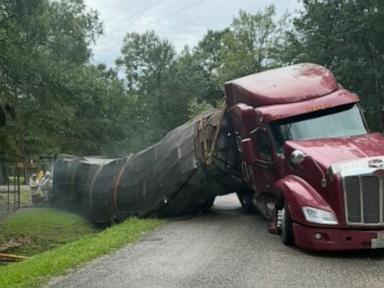
A wrong turn on a Sunday morning usually results in a minor headache and a delayed breakfast. But when you are steering an 18-wheeler loaded with 408 commercial beehives down a tight residential street, a wrong turn turns into an absolute nightmare.
That is exactly what happened on June 21, 2026, in a quiet pocket of Orange County, Texas. A semi-truck driver heading toward North Dakota missed his route, veered into a rural neighborhood near Mauriceville with narrow lanes, and flipped the entire trailer while attempting to navigate a sharp corner.
Within minutes, over two million honeybees flooded the area. Local emergency officials quickly shut down roads and issued an immediate shelter-in-place warning for everyone nearby.
The immediate news cycle treated it as a bizarre, viral spectacle. We see these headlines every few months—trucks spilling everything from extra-firm tofu to fireworks across interstate highways. But look past the initial shock of a neighborhood blanketed in a buzzing cloud of insects, and you find a story about a fragile agricultural supply chain, devastating financial losses, and a local rescue effort that tells you everything you need to know about the tight-knit world of American beekeeping.
The Morning a Texas Neighborhood Stood Still
Imagine walking outside to grab your morning paper and finding the sky thick with millions of displaced, highly stressed insects. That was the reality for residents east of Houston near the Louisiana border.
When the trailer tipped, hundreds of wooden hive boxes shattered. Honeybees do not naturally want to attack humans, but when their home is crushed and flipped upside down, their survival instincts kick into overdrive. The local emergency services did not mince words, telling residents to stay inside and close all windows immediately.
Amazingly, initial reports showed no serious injuries or severe mass stings. The driver escaped the wreck, and local emergency response teams kept a safe distance until the real experts arrived. Emergency workers do not have the gear or the specialized training to wrangle millions of angry bees. For that, you need a very specific kind of civilian backup.
The Unspoken Rule of the Beekeeping Community
When a crisis like this hits, nobody waits for a corporate memo. Christie Ray, the owner of Queen Bee Supply, located right in the area, watched the disaster unfold. She did not just sit back. Instead, she put out the call, and volunteers from three or four local, competing beekeeping operations dropped their Sunday plans, threw on their white protective suits, and rushed straight toward the danger.
Chris Moore, the owner of Moore Honey Farm, brought his son and a crew of employees to the scene. Think about that for a second. In most industries, if a competitor’s delivery truck crashes, rival companies do not send their own staff to sweat for hours in the Texas heat to salvage the product.
Beekeepers operate differently. They understand how precious these creatures are to the ecosystem and how brutal a loss like this is to an independent operator. Photos from the scene showed massive, swirling gray clouds of bees clinging to nearby trees while these masked volunteers carefully stacked what was left of the broken hives. They used smoke to calm the insects, working systematically to load the salvageable boxes onto transport trucks bound for a local honey farm.
The Devastating Math Behind a Commercial Hive Spill
The mainstream media covered the traffic delay and the spectacle. What they missed is the catastrophic economic blow dealt to the owner of these hives, whose identity hasn't even been publicly released yet.
Chris Moore assessed the wreckage firsthand and gave a grim estimate. He expects only about a quarter of those 408 hives to survive long-term.
To understand why the survival rate is so low, you have to look at how a colony works. A hive is not just a box of bugs. It is a highly complex social structure completely dependent on a single individual.
- The Queen Dilemma: If the queen bee dies in the physical crash, the entire colony is essentially doomed unless a new queen can be introduced immediately.
- The Stress Factor: Honeybees are sensitive to vibration and temperature. Crashing a truck, breaking their boxes, and exposing them to the elements causes extreme stress that leaves them vulnerable to disease and abandonment.
- The Drifting Problem: Millions of bees flying loose will lose track of their original colony. They swarm on nearby trees or wander into catch boxes set up by local keepers, breaking the organized structure required for commercial operations.
A commercial apiary does not just lose the physical wood boxes and the bees themselves. They lose months of future revenue. These specific hives had only traveled a few miles on what was supposed to be a massive journey across the country to North Dakota.
Commercial beekeeping is a migratory business. Operators move their hives thousands of miles every year to follow the blooming seasons. They go to California to pollinate almond orchards in the winter, head to the Midwest for clover in the summer, and move throughout the South for honey production. When an operator loses three-quarters of a 400-hive shipment in a single afternoon, it can wipe out their entire financial runway for the year.
What to Do If a Bee Swarm Takes Over Your Property
While this specific accident happened in rural Texas, truck spills involving bees are shockingly common. We saw a major bee spill slow down traffic near Knoxville, Tennessee, and another incident in North Dakota where a truck flipped after dodging a teenage driver.
If you ever find yourself living in a neighborhood where millions of bees have been released, you need to know how to handle it. Do not rely on common myths.
First, stay inside your house or vehicle. Close every window and turn off any outdoor ventilation systems that might pull insects inside. Honeybees looking for a new home after a trauma are looking for dark, enclosed spaces to protect what is left of their cluster. Your open window looks like a perfect cave.
Second, do not spray them with a garden hose or insect killer. Spraying a swarm with water will not make them leave. It will just agitate them and make them aggressive. Chemical sprays are useless against a cloud of millions of airborne insects and will only ruin the chances of a local beekeeper saving the colony.
Third, call the experts immediately. Local police and fire departments are essential for closing roads, but they cannot relocate a swarm. Contact a local beekeeping association or an apiary supply company. They have catch boxes designed to mimic a natural hive environment. They can place these boxes near the swarm, attract the remaining strays, and safely transport them away from residential properties without anyone getting hurt.
The insects in Orange County will take some time to fully clear out. Local keepers left catch boxes behind to gather the strays that scattered during the frantic Sunday rescue. It is a slow, tedious process, but it is the only way to restore safety to the neighborhood while keeping what is left of the essential pollinators alive.
Your Next Steps to Stay Safe and Support Local Beekeepers
Do not wait for an emergency to understand how the local agricultural network operates in your region.
Find and bookmark the contact information for your nearest local beekeeper association. If a swarm ever appears on your property, you will know exactly who to call instead of panicking.
Support your local apiaries by buying regional honey directly from the people who produce it. The families who rushed out on a Sunday morning to save millions of bees in Texas survive on razor-thin margins. Buying their products gives them the financial cushion they need to keep doing this essential, hazardous work.