Stop waiting for Cristiano Ronaldo to fade quietly into the background. It isn't going to happen. If you thought his move to Saudi Arabia or his 41 years of age meant he would accept a bit-part role for Portugal, you don't understand what drives the man.
The football world spent an entire week writing his sporting obituary. After a miserable 1-1 draw against DR Congo in Portugal's opening Group K match at the 2026 World Cup, pundits went into overdrive. Lionel Messi already had a hat-trick and a brace to his name. Kylian Mbappe was terrorizing defenses with back-to-back braces. Erling Haaland had already bagged four goals in his first two games on the World Cup stage.
Meanwhile, Ronaldo looked isolated, static, and old. He touched the ball just 25 times against DR Congo. He didn't manage a single shot on target. The narrative was set, the scripts were written, and the social media experts declared that Roberto Martinez was actively harming Portugal by starting a legacy act.
Then Tuesday night happened in Houston.
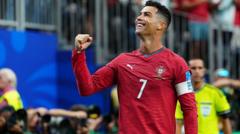
Portugal dismantled Uzbekistan 5-0 under the roof at the Houston Stadium. Ronaldo didn't just score; he completely re-established his dominance, netting twice in the first half and reminding everyone that writing him off is the ultimate footballing mistake. When the final whistle blew, he walked straight up to the television camera, stared into the lens, and shouted two words that will define this stage of his career: "I'm back! I'm back!"
This wasn't just a relief for a struggling team. It was a calculated, angry response from an athlete who feeds on doubt.
The Six World Cup Club of One
Let's look at the numbers because they border on the absurd. By turning Joao Cancelo's cross into the net at the near post just six minutes into the match, Ronaldo became the first football player in history to score at six different World Cups. Think about the longevity required to achieve that. It spans more than two decades of international football at the absolute highest level.
Most players are lucky if their careers last a decade. Ronaldo has been scoring on the biggest international stage across four different eras of the game.
His first World Cup goal came back in 2006 against Iran. Back then, he was a skinny, tricky winger with blond highlights and a penchant for stepovers. Today, he's a pure penalty-box predator, a clinical finisher who knows exactly how to manipulate defenders with a single movement. The style has changed completely, but the outcome remains identical.
Against Uzbekistan, you could see the fear he still instills in opposing backlines. For Portugal's second goal in the 17th minute, Nuno Mendes stood over a free-kick just outside the penalty area. Fabio Cannavaro's Uzbekistan side set up their defensive wall expecting Ronaldo to take the shot. Ronaldo made a subtle, decoy run, dragging the defenders' attention with him, which allowed Mendes to step up and drive the ball directly home.
That's the tactical gravity Ronaldo possesses. Even when he isn't striking the ball, he dictates what the opposition defense does.
Why the DR Congo Backlash Was Massively Blown Out of Proportion
The rush to judge Ronaldo after the opening match shows how short football memories really are. People love to point to his age as an easy explanation for any poor team performance. If Portugal draws, it must be because a 41-year-old is dragging them down.
Honestly, the problem against DR Congo wasn't Ronaldo's lack of movement. It was the lack of service. Roberto Martinez's midfield failed to transition the ball forward with any real speed, leaving the frontline completely starved of opportunities. When a striker gets no service, they look anonymous. It happens to Erling Haaland, it happens to Kylian Mbappe, and it certainly happens to Ronaldo.
Against Uzbekistan, Martinez adjusted the tactical setup. Portugal played with much higher intensity from the opening whistle. Bruno Fernandes and Joao Cancelo were given explicit instructions to find the half-spaces and feed early balls into the box.
The tactical shift paid dividends immediately. Look at Ronaldo's second goal in the 39th minute. Bruno Fernandes spotted a gap in the Uzbek defense, slipped a perfectly weighted pass through, and Ronaldo timed his run to perfection before striking it past Abduvohid Nematov. It was classic, efficient football. No fuss. No overthinking. Just elite movement and clinical execution.
The Mental Tax of Being Cristiano Ronaldo
After the match, Ronaldo was incredibly candid about the emotional weight of the past week. He didn't hide his frustration with the media or the fans who were so quick to turn on him.
"I can say it was a very tough week, where public opinion was very harsh on us, on all the players, but especially on me and the coach," Ronaldo admitted in his post-match interview. "I've been a professional for 23 years. When things go well, Cristiano is great; when things go badly, he's 'finished' or 'too old.'"
That quote tells you everything you need to know about his mindset. He knows exactly what people say about him. He reads the articles, he hears the talk shows, and he uses every single scrap of negativity as fuel.
Most 41-year-old athletes with five Ballon d'Or trophies and countless millions in the bank would have walked away by now. They would be sitting on a beach or managing a club. Ronaldo is still putting his body through intense physical strain because he has an insatiable need to prove people wrong. He refuses to let anyone else dictate the terms of his retirement.
We see a lot of synthetic, media-trained responses in modern sports. Players rarely say what they actually think. Ronaldo's outburst into the camera wasn't elegant, but it was entirely authentic. It was the raw emotion of a man who felt backed into a corner and punched his way out.
Can Portugal Actually Win the 2026 World Cup with a 41-Year-Old Striker
This is the real question that international football experts are debating. Scoring twice against an Uzbekistan side managed by Fabio Cannavaro is one thing, but navigating the knockout rounds against France, Argentina, or Brazil is a completely different challenge.
To understand if Portugal can go all the way, you have to look at the balance of the squad. This isn't the Portugal of ten years ago, where Ronaldo had to carry the entire creative burden on his back. Roberto Martinez has an embarrassment of riches at his disposal.
- Bruno Fernandes provides world-class vision and passing from advanced midfield positions.
- Rafael Leao brings terrifying pace and directness on the flank, as shown by his brilliant goal in the 87th minute to round off the 5-0 win.
- Bernardo Silva offers elite ball retention and tactical intelligence to control the tempo of matches.
- Nuno Mendes and Joao Cancelo provide dynamic attacking threat from the fullback positions.
When you surround Ronaldo with that much elite creative talent, he doesn't need to run 12 kilometers a game. He doesn't need to press high up the pitch for 90 minutes. He just needs to occupy the center-backs, create space for his teammates, and finish the chances that come his way.
The own goal by Nematov in the 60th minute came from a wicked cross that was bound for Ronaldo anyway. Defenders panic when he's in the box, and that panic creates goals, whether he touches the ball or not.
The idea that Ronaldo holds Portugal back is a fundamental misunderstanding of modern tournament football. In a short, high-stakes tournament like the World Cup, clinical efficiency inside the penalty box is worth more than endless running.
What to Expect Next from Group K
Portugal's emphatic bounce-back victory completely reshapes the dynamic of Group K. They looked completely broken after the opening match, but now they possess the goal-difference advantage and the momentum heading into the remainder of the group stage.
If you're tracking Portugal's progress or trying to understand how this tactical setup will hold up, here are the core factors to watch over the coming days:
- Monitor the physical recovery of Ronaldo. Playing 90 intense minutes at his age takes a massive toll, and Martinez will need to manage his minutes carefully if Portugal goes deep into the tournament.
- Look at the midfield selection. The partnership between Bruno Fernandes and the deeper midfielders dictates how much service the frontline receives. If the midfield gets sluggish, the entire team stalls.
- Watch how opposing managers adapt. Uzbekistan tried to play a relatively brave defensive line and got punished. Future opponents will likely sit in a deep low-block to deny Ronaldo space in the box.
The critics haven't disappeared forever. They're just quiet for now, waiting for the next slip-up. But if Tuesday night in Houston proved anything, it's that Cristiano Ronaldo is nowhere near finished. He's still the main event.