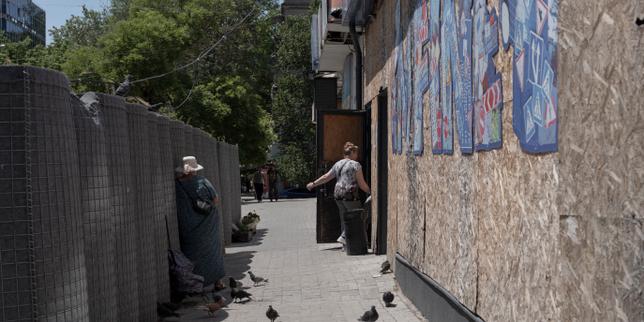
Imagine stepping out of your front door to buy bread, walking your dog, or waiting for a bus, while knowing an unblinking eye in the sky is tracking your every step. You hear a high-pitched buzz. Within seconds, a first-person view (FPV) drone drops a fragmentation grenade directly at your feet.
This isn't a dystopian movie. It's the daily reality for thousands of Ukrainian civilians in Kherson.
While international news focuses on massive missile strikes, frontline shifts, and geopolitical treaties, a hyper-localized campaign of targeted drone strikes is terrorizing this southern Ukrainian city. Local residents call it a "human safari," and the evidence shows it's a deliberate, systematic strategy to make Kherson completely unliveable.
The Reality of the Kherson Human Safari
For over a year, Russian forces stationed just across the Dnipro River on the occupied left bank have deployed thousands of small, cheap commercial drones modified with explosives. Unlike long-range missiles or heavy artillery, these drones aren't aimed at hidden ammunition depots or troop concentrations. They are hunting people.
According to a United Nations investigation, Russian drone operators use real-time video feeds to target individuals who are visibly civilian. They watch them through their monitors and make a conscious decision to drop munitions on pedestrians, cyclists, and private cars.
The numbers are staggering. Official Ukrainian prosecutor reports note that since the full-scale invasion began, Russian drone attacks have killed more than 300 civilians, including three children, in Kherson Oblast alone. Nearly 3,000 others have been maimed, suffering severe blast injuries, shrapnel wounds, and amputations. During just the first four months of 2026, targeted drone strikes killed 35 people and wounded 385.
The terror isn't random. It follows a distinct pattern designed to maximize casualties and completely collapse municipal life.
Why Russian Drones Target First Responders and Minibuses
If you look closely at how these drone units operate, you notice a deeply sadistic tactic: the "double-tap" strike.
When an initial drone strikes a civilian walking down a main street, the operator doesn't just fly away. They wait. They wait for neighbors, ambulances, or State Emergency Service teams to arrive on the scene. Then, a second or third drone strikes the rescuers.
In May 2026, the World Health Organization's Surveillance System for Attacks on Health Care recorded dozens of attacks on medical facilities and staff. This included a targeted drone attack on medical personnel in Kherson who had just arrived to treat victims of a previous strike. Emergency workers are forced to make an agonizing choice: rush out to save a bleeding neighbor immediately or wait and risk letting them die because a drone is hovering overhead, waiting to kill the rescue crew.
Public transportation has also been systematically targeted to paralyze the city. In early May 2026, a Russian drone struck a civilian minibus in Kherson, killing two people and wounding seven. Hours later, another drone hunted down a second minibus, targeting the driver. In April 2026 alone, drone units damaged or destroyed at least 230 vehicles, including private cars, public transit, and clearly marked humanitarian supply trucks.
Inside the Mind of the Operators
What makes this campaign especially horrifying is that the operators see exactly who they are killing. They see the lack of uniforms, the grocery bags, the elderly people walking with canes, and the children playing in backyards.
In June 2026, the Security Service of Ukraine (SBU) identified ten Russian servicemen from the 404th Motor Rifle Regiment of the Dnepr grouping who were directly involved in these short-range drone attacks against civilians.
Investigators uncovered that these soldiers weren't just executing tactical operations; they were filming the killings. The graphic video feeds from these FPV kamikaze and fiber-optic drones are regularly posted to Russian Telegram propaganda channels, where they are treated like highlights from a video game or celebrated as "training exercises" for rookie pilots. The UN Human Rights Commission officially classified the posting of these videos as an outrage upon personal dignity, a recognized war crime.
How Kherson is Fighting Back From Below
Living under a permanent sky-borne siege has fundamentally transformed human behavior in Kherson.
People don't look at the weather the way you and I do. Blue skies and clear, sunny days are terrifying because they offer perfect visibility for drone cameras. Instead, locals wait for dense fog, heavy rain, or thick cloud cover to run their errands. They walk tight against the walls of buildings, darting from tree canopy to tree canopy to break the line of sight from above.
The Ukrainian government and local volunteers are scrambling to deploy defensive counters, but the sheer volume of incoming drones makes it a brutal numbers game. Between January and April 2026, Ukrainian electronic warfare and air defense units managed to intercept roughly 55,000 Russian drones out of 58,000 deployed in the region.
That is an astonishing 95% success rate. But it also means 3,000 explosive drones still slipped through the net to rain down on homes, streets, and markets.
To counter the short-range FPV threats, Ukraine has begun installing massive physical barriers. Hundreds of kilometers of local roads and highways are now covered with towering anti-drone netting draped over steel posts, designed to catch or detonate the incoming UAVs before they hit vehicles or pedestrians.
The Strategic Goal is Clear
This isn't an accidental byproduct of urban combat. The scale and coordination of these strikes suggest a deliberate state policy of forced population transfer. By rendering daily life impossible—by ensuring you cannot safely go to work, visit a hospital, or drive a car—the Kremlin wants to empty Kherson completely.
The plight of Kherson is a chilling, real-time preview of how commercial technology can be repurposed into an omnipresent weapon of terror. It is a warning to the rest of the world about the changing face of modern conflict, where the frontline isn't a distant trench, but the airspace right above a residential sidewalk.
Critical Next Steps for International Observers and Policy
To effectively counter this evolving form of warfare and support the civilian population, immediate international actions must shift toward specialized defense and legal accountability:
- Fund Electronic Warfare Jamming Systems: International aid needs to prioritize funding for localized, portable electronic warfare (EW) "domes" that can jam drone signals around hospitals, fire stations, and civilian transit hubs.
- Expand Physical Shielding Infrastructure: Support the manufacturing and deployment of specialized steel anti-drone netting for civilian corridors and public utilities.
- Track Drone Supply Chains: Western governments must tighten export sanctions on electronic components, fiber-optic tethers, and commercial chips that continue to find their way into Russian assembly plants.
- Document and Prosecute Drone Operators: International legal bodies must use the digital footprints left by drone units on social media to build war crime dossiers against specific operators and their commanding officers, ensuring there is no anonymity for targeted civilian killings.