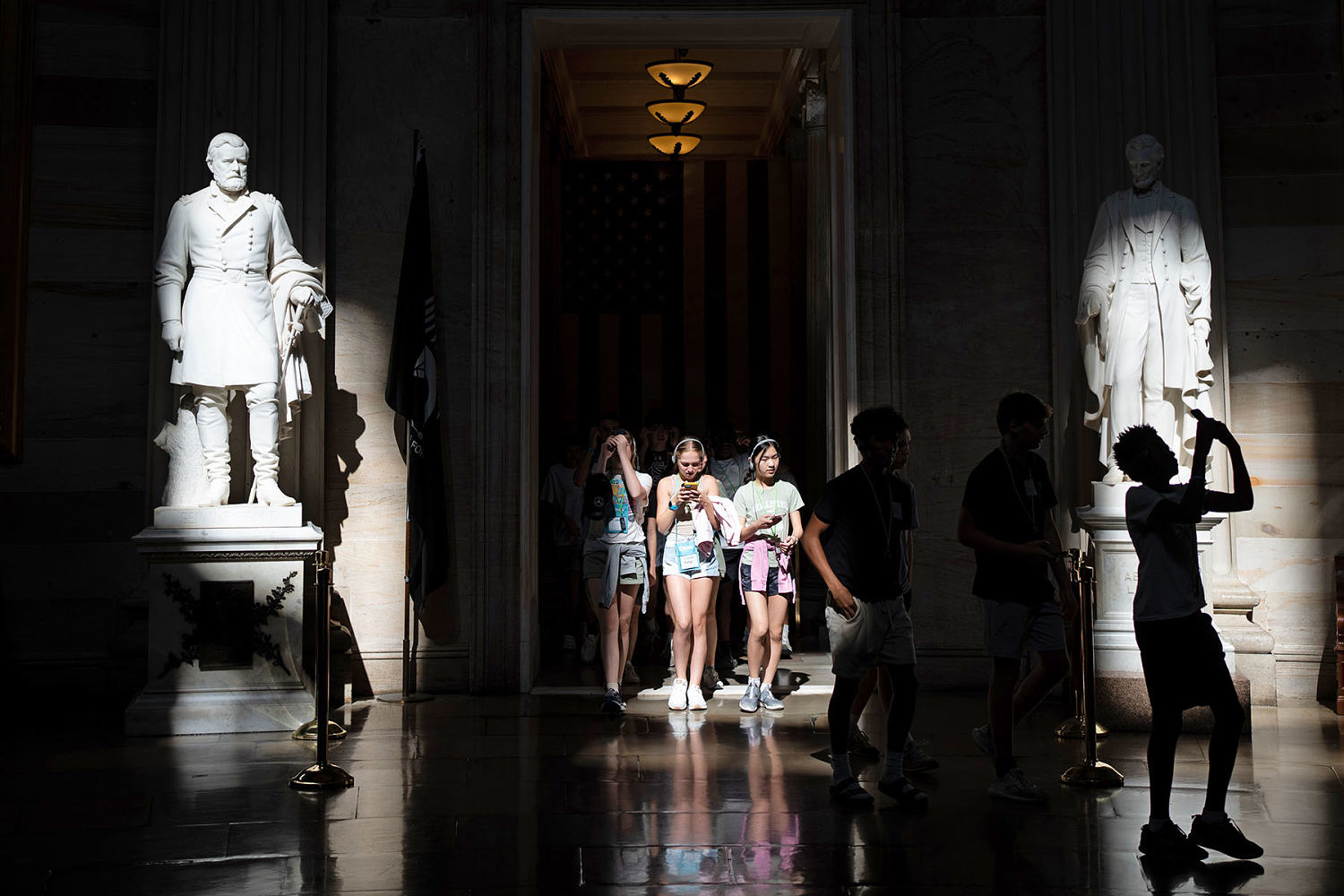
We have a massive problem with how we talk about our government. Everyone complains that the political system is broken. Everyone screams at their television screens. Yet, almost nobody wants to look at the real root cause of our fractured public square. We simply stopped teaching people how a self-governing society actually functions.
A few years ago, a striking national poll confirmed what many educators already knew. The vast majority of Americans across the political spectrum believe that our education system does not teach enough about democracy. This isn't a partisan talking point. It is a shared national anxiety. People feel disconnected from their own government because they were never given the keys to understand it. If you enjoyed this article, you might want to look at: this related article.
When you look closely at the data from major civic studies, including research supported by organizations like the George W. Bush Institute and Freedom House, a staggering 89% of citizens favor boosting civic education to protect our system of governance. Despite this overwhelming consensus, our classrooms remain remarkably silent on the topic. We are trying to run a high-tech, modern society on an educational foundation that treats the mechanics of voting and constitutional rights as an afterthought.
If we want to fix our polarized culture, we have to start where future citizens spend their formative years. We need to completely overhaul our approach to teaching democracy. For another perspective on this story, see the latest update from Associated Press.
The Cost of Squeezing Civics Out of the Classroom
How did we get here? It didn't happen by accident. For decades, public schools operated under a clear dual mandate. They were supposed to prepare kids for the workforce, and they were supposed to prepare them for citizenship. Early education pioneers like Horace Mann argued that a republic without an educated public would quickly turn into a disaster.
Then the policy shifted.
The introduction of sweeping federal accountability laws like the No Child Left Behind Act changed everything. Suddenly, school funding, teacher evaluations, and district reputations were tied almost exclusively to standardized test scores in reading and math.
What gets tested gets taught. What doesn't get tested gets dropped.
Social studies and civics were pushed to the absolute margins. In many elementary schools, dedicated social studies time dropped to less than an hour a week. High schools reduced their civics requirements to a single semester, often crammed into the final year when senioritis has already set in.
We traded systemic civic understanding for short-term test scores. The results of that trade are hitting us hard right now. According to long-term data from the Annenberg Public Policy Center, only about a quarter of American adults can successfully name all three branches of government. A shocking number of people cannot define what the First Amendment actually protects.
When citizens don't understand how the system is built, they can't maintain it. They become easy targets for misinformation, cynicism, and anger.
The Dangerous Myth of Inherent Citizenship
We often treat civic knowledge like it's a genetic trait. We assume that because someone is born in a free country, they automatically understand how to preserve it. This is a dangerous lie.
Democratic norms are learned behaviors. They require a specific set of skills that must be practiced, tested, and refined. You aren't born knowing how to evaluate a policy proposal. You aren't born knowing how to spot a logical fallacy in a political advertisement. You certainly aren't born with the patience required to sit through a local city council meeting.
What Real Civic Preparation Looks Like
True education about our system requires three distinct pillars. If you miss any of them, the whole structure collapses.
- Core Knowledge: You need to understand the structural architecture. This means studying the Constitution, the separation of powers, federalism, and the historical struggles to expand voting rights.
- Cognitive Skills: You must know how to analyze arguments, read the news critically, and separate verified facts from hyper-partisan commentary.
- Civic Disposition: This is the emotional component. It involves a commitment to compromise, respect for the rule of law, and a willingness to listen to people who disagree with you.
Most schools, when they teach this topic at all, focus strictly on the first pillar. They force students to memorize how a bill becomes a law or memorize the names of the Supreme Court justices. Then they give a multiple-choice quiz and move on.
That isn't learning democracy. That is compliance training.
It does nothing to prepare a young person for the messy, frustrating reality of actual political engagement. It doesn't show them how to write a letter to a representative, how to organize a community cleanup, or how to talk across lines of political division without destroying a relationship.
Why Social Media Filled the Vacuum
When schools stopped providing a structured, objective framework for understanding power and governance, young people didn't stop looking for answers. They simply turned to the algorithms.
Today, the dominant source of political socialization for young Americans isn't a textbook or a teacher. It is a social media feed. Platforms are designed to maximize engagement, and nothing drives engagement quite like outrage, division, and fear.
Data from nonpartisan groups like More in Common shows a direct link between extreme social media usage and a rise in cynical, antidemocratic attitudes. When you spend five or more hours a day immersed in online echo chambers, your view of your fellow citizens warps. You start to see political opponents not as neighbors with different ideas, but as existential threats that must be destroyed by any means necessary.
A well-funded, media-literate civics curriculum acts as an armor against this online manipulation. It gives students the tools to pause, fact-check, and realize when a piece of content is intentionally pulling their emotional triggers. Without that armor, our youth are being swept away by a tidal wave of digital propaganda.
The Disparity in Who Gets Taught
The civic education deficit isn't distributed evenly. It follows the exact same fault lines of race and income that plague our broader economic system.
Research from organizations like the Center for Information and Research on Civic Learning and Engagement (CIRCLE) at Tufts University reveals a massive "civic empowerment gap." Students in wealthy, suburban districts are much more likely to have access to high-quality interactive civics classes, debate teams, and mock trial programs. They are encouraged to discuss current events and voice their opinions.
Students in underfunded urban and rural schools are frequently subjected to rote memorization or have their social studies classes cut entirely to make room for remedial math and reading drills.
This creates a self-perpetuating cycle of political inequality. The kids who already have societal advantages are trained to see themselves as leaders and change agents. The kids who are already marginalized are taught that government is something that happens to them, not something they have a right to shape.
We can't claim to have a government of the people, by the people, and for the people if we only teach a select fraction of those people how the system actually works.
Turning the Tide at the Local Level
Fixing this crisis won't happen through a grand decree from Washington. Education policy is primarily a state and local responsibility. If we want our kids to learn about our system of self-governance, we have to change the priorities of our local school boards and state legislatures.
Mandate Action-Oriented Curriculum
We need to abandon the dry, textbook-only model. States should mandate "action civics" programs where students don't just read about local government—they engage with it.
Imagine a high school class where students identify a specific problem in their neighborhood, research the local ordinances, interview public officials, and present a formal proposal to the city council. That is how you build lifelong voters. They learn that their voices have power, and they learn exactly how to navigate the bureaucratic channels to get things done.
Protect Classroom Discussions of Current Events
Teachers are terrified right now. The intense polarization of our national politics has turned classrooms into ideological minefields. Many educators are choosing to stay completely away from any controversial topic because they fear backlash from angry parents or hyper-partisan activist groups.
This silence is deadly for a democratic society. If students don't learn how to discuss difficult, controversial issues in a structured environment guided by an objective professional, where will they learn it? On the internet?
School boards must create clear, explicit policies that protect and support teachers who lead balanced, evidence-based discussions on current events. We must give educators the air cover they need to do their jobs effectively.
Update State Testing Requirements
If states insist on keeping high-stakes testing, then civics must be included in the equation. Several states have moved toward requiring high school students to pass the same civics test that immigrants take to become naturalized citizens.
While that is a start, it shouldn't be the final destination. We should push for comprehensive social studies assessments that value critical thinking, media literacy, and historical analysis over simple memorization. When state governments signal that civic literacy matters just as much as math and science proficiency, school districts will reallocate their resources accordingly.
Take Responsibility Into Your Own Hands
Don't wait for the bureaucrats to save us. Every citizen can take immediate action to address the civic literacy gap in their own community.
Attend your local school board meeting. Ask the superintendent exactly how many hours of civics instruction elementary students receive each week. Demand to see the high school social studies curriculum. Support nonpartisan organizations that provide free, high-quality civic resources to teachers. Talk to your kids or your younger relatives about how your local government works. Take them with you when you go to vote. Show them that participation is a duty, not an option.
We are watching the consequences of civic neglect play out in real time every day. A free society is a fragile thing. It doesn't stay alive on autopilot. It requires a constant, deliberate investment in the minds of the next generation. Stop assuming our system will survive simply because it has survived so far. Get involved, demand better from your local schools, and start rebuilding our democracy from the classroom up.