Ten years ago today, Britain voted to leave the European Union. Fast forward to right now, June 23, 2026, and the continent isn't just looking at the UK with a raised eyebrow anymore. They're openly laughing. Or crying. Honestly, it's hard to tell the difference these days.
The abrupt resignation of Keir Starmer yesterday means the UK is about to welcome its seventh prime minister since the 2016 Brexit referendum. Seven. In a decade. For a country that used to lecture the rest of the world on the virtues of institutional stability, the joke writes itself. Across the English Channel, the continental press isn't pulling any punches. They see a nation trapped in an endless, self-inflicted loop of political musical chairs.
If you want to understand how the rest of the world views Britain's current tailspin, you only have to look at the front pages of Europe's biggest newspapers. The consensus is brutal, unanimous, and highly synchronized.
The Transit Station of Europe
In Germany, the heavyweight news magazine Der Spiegel ran with a headline that cuts straight to the bone: "Downing Street Transit Station." They compared 10 Downing Street to a bustling railway hub where leaders hustle in and out before they even have time to unpack their bags. They didn't mince words about the lineage of failure either, cataloging a decade of dysfunction stretching from David Cameron (the gambler) and Boris Johnson (the populist) to Liz Truss (the six-week wonder) and now Starmer.
Over in Spain, La Vanguardia concluded that Number 10 must have been fitted with a literal revolving door. They noted that Britain's much-vaunted political stability is entirely a thing of the past. Instability is the new British baseline.
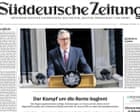
What's really catching the eye of European editors isn't just that another prime minister fell. It's the sheer, blinding speed of the collapse. Germany's liberal-leaning Süddeutsche Zeitung pointed out that while it's normal for voters to sour on a government, the dizzying pace at which Starmer transformed from a landslide election winner into an absolute political villain is astonishing.
Connecting the Dots to 2016
Let's be clear about something the British press sometimes likes to sweep under the rug. European analysts aren't treating Starmer's downfall as an isolated incident of bad communication or localized party plotting. They're tying it directly to the 10-year anniversary of the Brexit vote.
France's Libération ran a scathing post-mortem detailing "10 years of Brexit and an immense waste." Their view is that Starmer didn't win a mandate because people loved his vision; he won because voters desperately rejected the Conservatives. Once in power, he was immediately crushed by the economic and structural realities of a post-Brexit Britain.
Spain's El País was even more direct, running a feature on "the political crisis in Britain" with a headline pointing to the "broken promises of a Brexit that made everything worse." They noted with sharp irony that while neither the UK economy nor its welfare state are better off, the exact same political right-wing forces that drove the country out of the EU are now stronger than ever.
Denmark's financial daily Børsen summarized the tragedy on its front page, stating that Starmer was simply "chased down by both the recent and the distant past." You can't run a country when the structural foundations have been systematically dismantled.
Why Andy Burnham Won't Fix the Underlying Rot
With former Manchester Mayor Andy Burnham currently the hot favorite to take over the keys to Downing Street, the European press is already managing its expectations. The Frankfurter Allgemeine Zeitung explicitly warned that a fresh face at the top won't change the underlying structural forces that dislodged the previous six prime ministers.
The next leader will inherit the exact same nightmare that broke Starmer:
- Extreme national debt paired with anemic economic growth.
- Completely threadbare public services screaming for investment.
- Global energy pressures tied to the ongoing conflict involving the US, Israel, and Iran.
- The looming unpredictability of dealing with a volatile Trump administration in Washington.
A comment piece in the German press asked a question usually reserved for England football managers: Is being the British Prime Minister simply an impossible job now?
A century ago, Britain competed with the United States for global hegemony. Today, as El País dryly observed, its economy languishes and its politics are left in tatters. To the journalists and citizens watching from Paris, Berlin, and Madrid, the UK has traded its reputation for serious statecraft to become Europe's favorite reality TV show.
What to Do Next
If you are tracking global market stability or managing European-UK cross-border operations, stop waiting for the next prime minister to provide a magical "reset."
- Price in Permanent Instability: Treat the UK political landscape as a volatile, high-turnover environment. Assume any regulatory framework or political promise has a shelf life of less than two years.
- Watch the Rejoin Sentiment: Keep a close eye on polling data. With over 60% of Gen Z Britons now favoring a vote to rejoin the EU, the long-term political pressure is shifting. Look at structural alignments that hedge for a potential, long-term regulatory pivot back toward Brussels.
- Monitor Infrastructure Borrowing: Watch Burnham's incoming policy indicators closely. His advisers are already calling for billions in infrastructure borrowing. If executed, this will fundamentally shift UK bond market dynamics and currency volatility before the autumn.


