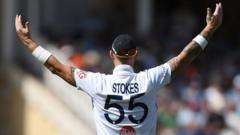
English cricket loves a drama, but nobody saw this one coming. Right in the middle of a tense third Test match against New Zealand at Trent Bridge, Ben Stokes decided he was done. He didn't wait for a quiet press conference at the end of the summer or a glossy television special. He told his teammates in the dressing room on Sunday morning, went out on the pitch, and let the England and Wales Cricket Board drop the official announcement while he was literally in the middle of a bowling spell.
Then, because the man operates entirely on cinema, he went out and took a wicket with his very next delivery. Zak Foulkes was caught at second slip. The Nottingham crowd went completely wild. Discover more on a similar subject: this related article.
Losing a player of this magnitude is one thing. Losing him during a live Test series when everything is on the line is pure Stokes. Former England captain Michael Vaughan hit the nail on the head when he observed that the squad is going to desperately miss that raw, winning aura. It's an understatement. Stokes isn't just an all-rounder who scores runs and takes wickets. He is the competitive heartbeat of the entire national setup. When he walks away at the end of this Trent Bridge Test, English red-ball cricket enters uncharted, terrifying territory.
http://googleusercontent.com/lmdx_content/wUvDKPILnJIUqQxFZJaqiGEZOdaErUxgAbgMULAONxAvlPLmPRclQFfndYKOdjbaGygSbTbjzgaiLbSdwpdfLFLXnWCWImGiIyzboTtNNxSQYeEtcWbAZOcYWkRYYhqOtsrExoSNYBgHC11497 Additional reporting by CBS Sports explores comparable perspectives on this issue.
The Breaking Point Behind the Shock Retirement
This wasn't a sudden flash of inspiration. The roots of this departure trace back to the massive friction that built up earlier this June. After leading England to a victory in the first Test at Lord's, Stokes and fast bowler Gus Atkinson broke a midnight team curfew at a London nightclub. The fallout was messy. Rumours swirled of a confrontation involving rugby players, and the hierarchy at Lord's clamped down hard.
The board stood both players down for the second Test at the Kia Oval. Stripped of their talisman, a leaderless England looked completely lost. They suffered a bruising 253-run thrashing as New Zealand effortlessly leveled the three-match series.
Though an internal investigation eventually cleared Stokes of any long-term wrongdoing, the damage to the relationship was obvious. Behind the scenes, relations between the captain and the board executives grew incredibly strained. Reports suggested Stokes even considered walking away from international duty immediately during the height of the media storm. He chose to return for the decider at Trent Bridge to face the music, issuing a frank public apology to his teammates for the distraction his actions caused.
But the tank was running empty. At 35 years old, after 122 Tests of pushing his body far past its physical limits, the mental toll of the modern captaincy combined with off-field scrutiny forced his hand. He decided to make one final trip to the well.
A Legacy of Pulling Off the Outright Impossible
You can't understand what England is losing without looking at the sheer absurdity of what Stokes accomplished across his 15-year international career. Statistics don't do him justice. He was never a player defined by a tidy batting average or an economical bowling economy. He was a specialist in the impossible.
When England looked completely dead and buried, Stokes found a way to win. Think back to the summer of 2019. The 50-over World Cup final at Lord's against New Zealand was descending into chaos, and his unbeaten 84 dragged England into a Super Over that secured their historic first world title. Weeks later, he headed to Headingley for the third Ashes Test. Chasing 359, England slumped to nine wickets down, needing 73 more runs. Alongside number eleven Jack Leach, Stokes played an innings of sheer, unadulterated madness, finishing 135 not out to snatch victory from the jaws of absolute certainty.
That is what Michael Vaughan means by a winning persona. Some players settle for solid tactical choices. Stokes altered the emotional gravity of the entire ground. When he walked out to bat, opposition captains stopped thinking about how to get him out and started worrying about how to stop a runaway train.
The Brutal Reality of Life After Bazball
When Stokes took over the Test captaincy in April 2022 alongside head coach Brendon McCullum, they completely transformed how the longest format of the game is played. They threw out the old textbook on defensive accumulation and replaced it with a hyper-aggressive, fearless style that fans dubbed Bazball. It saved English Test cricket from a dismal run of one win in 17 matches and made them the most entertaining team on the planet.
Now, that entire philosophy faces an existential crisis. Bazball only works if the players have total, unshakeable belief in the man leading the charge. You need a captain who is willing to lose a match in order to chase a miraculous win. Without Stokes acting as the shield, younger players might easily slip back into self-doubt.
Look at what happened at the Oval when Joe Root had to step back into the captaincy hot seat. Root is an all-time batting great, but his leadership style is inherently more traditional, more cautious. The team looked stripped of its identity. The aggressive edge disappeared, and New Zealand picked them apart with ease.
Vice-captain Harry Brook is widely expected to take over the full-time leadership role next. Brook has the attacking instincts, but he's young and already carries the heavy burden of captaining the white-ball sides. Asking him to shoulder the weight of an entire red-ball transition while replacing a legendary figure is a massive gamble.
The Action Plan for the England Management
The international summer won't stop for a mourning period. Following this New Zealand decider, the red-ball side gets a seven-week breathing space before heading into a grueling three-match series against Pakistan in August. The England management cannot afford to waste a single day of that break.
First, Rob Key and the selectors must officially resolve the leadership structure. If Harry Brook is the chosen successor, he needs to be given absolute backing and clear boundaries to establish his own voice rather than trying to mimic the Stokes playbook.
Second, the team must address the massive balance issues caused by losing a genuine world-class all-rounder. You don't just replace a guy who bats in the top six and bowls crucial 90-mile-an-hour spells. England will likely have to restructure their entire lower order, potentially playing an extra specialist batsman and relying on a rotating cast of part-time bowlers to share the workload.
The post-Stokes era is going to be incredibly rocky, and the free-wheeling, carefree days of the last four years are officially over. Fans need to brace themselves for a much more volatile, experimental side as England figures out how to win without their ultimate security blanket.