You think you know how spiders hunt. They spin a sticky web, sit around, and wait for a clumsy fly to blunder into it. It's a classic passive strategy.
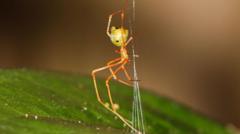
But a newly discovered arachnid in the remote rainforests of far north Queensland just flipped that entire playbook upside down. Meet the ballista spider, a tiny creature belonging to the genus Propostira that has engineered a hunting mechanism so violent and precise it sounds like science fiction.
Instead of waiting for an insect to get stuck, this spider uses a high-powered, spring-loaded web catapult to physically launch aggressive ants into the air.
If you are looking for a story about nature's raw engineering power, this is it. Scientists recently published their findings in Current Biology, and the mechanics behind this web are mind-blowing.
The 140G Trap Built to Hunt Monsters
Let's look at the target first. The ballista spider doesn't hunt harmless gnats. It specializes in preying on the green tree ant (Oecophylla smaragdina). If you've ever encountered these ants in northern Australia, you know they're nightmare material for small predators. They are fiercely territorial, pack a wicked bite, use potent chemical defenses, and can rapidly summon thousands of nestmates for backup.
Most spiders stay far away from them. The ballista spider actively lures them in.
Every night, this tiny nocturnal spider drops down from the safety of its leaf retreat to the forest floor or a nearby branch. It spends up to four hours meticulously crafting its weapon. It spins anywhere from 15 to 60 vertical silk tension lines, bundling them together into a small, tense, cone-shaped scaffold near the ground.
Once the tension is set, the spider retreats upward and waits.
When a green tree ant comes across the cone, it doesn't just walk away. Scientists suspect the spider coats the base with a highly specific pheromone that mimics an enemy or food, provoking the ant. The ant gets aggressive. It bites down hard on the silken cone to attack it.
That single bite acts as the trigger.
The moment the ant severs the anchor point, the stored elastic energy in the silk lines releases instantly. The ant is yanked off its feet and catapulted over 30 centimeters straight up into the spider's core web. The acceleration reaches an astonishing 1,367 meters per second squared. That is roughly 140 times the force of gravity ($140\text{g}$). For context, that is nearly 15 times the maximum g-force a fighter pilot can endure before blacking out. It's a force that would easily kill a human.
Why This Subverts Evolutionary Biology
Before this discovery, we knew of a few spiders that used active motion. Net-casting spiders throw webs, and slingshot spiders launch themselves alongside their webs. But the ballista spider breaks two fundamental rules of arachnid behavior.
First, the snare is triggered entirely by the prey, not the predator. In almost every other known mechanical web trap, the spider sits on a trigger line, senses a nearby target, and releases the tension itself. Here, the spider stays completely out of the equation. It sets the landmine, goes upstairs, and lets the ant commit accidental suicide.
Second, this is the only known example of a web engineered to target a single, specific species. This extreme specialization is what drove the evolution of such intense biomechanical performance. Green tree ants have powerful adhesive pads on their feet that grip surfaces with incredible strength. To break that grip and lift the ant before it can react or call for backup, the web needs massive instantaneous power density.
Gram for gram, this web stores more energy and exerts more power than any biological catapult ever recorded. A single kilogram of this specialized silk would theoretically exert 11.73 megawatts of power. By flinging the ant high into the air, the spider isolates the dangerous prey from its colony trails, keeping itself safely out of harm's way.
The Backstory of the Discovery
This bizarre hunting behavior wasn't easy to capture. Spider taxonomist Professor Greg Anderson first spotted a strange blur of movement in the Queensland rainforest back in 2022. He saw an ant vanish into the air but lacked the specialized gear to prove what just happened.
It wasn't until Associate Professor Ajay Narendra from Macquarie University and postgraduate student Pranav Joshi took a trip deep into the jungle near Cooktown that the mystery was solved. They spent 10 grueling days and nights tracking the tiny arachnids. By setting up specialized high-speed and infrared cameras in the pitch black, they finally caught the fraction-of-a-second launch on film, revealing the physics behind the blur.
How to Apply These Insights
While you probably aren't building silk catapults in your backyard, the discovery of the ballista spider offers a massive lesson in problem-solving and engineering that applies directly to human technology.
- Study bio-inspired engineering: Material scientists and roboticists are constantly looking at how spiders store elastic energy without heavy machinery. Look up research on biomimicry and synthetic silk to see how industries are trying to replicate these high-tensile, energy-storing properties for micro-robotics or medical devices.
- Re-evaluate specialization: In business and design, trying to please everyone often fails. The ballista spider survives in a brutal environment because it perfected a tool for one single, dangerous target. Apply that hyper-focus to your own projects or niche skill sets.
- Follow the latest arachnid research: The spider is still awaiting its formal scientific species name. Keep an eye on open-access journals like Current Biology to track how this discovery reshapes our understanding of evolutionary biology over the coming months.