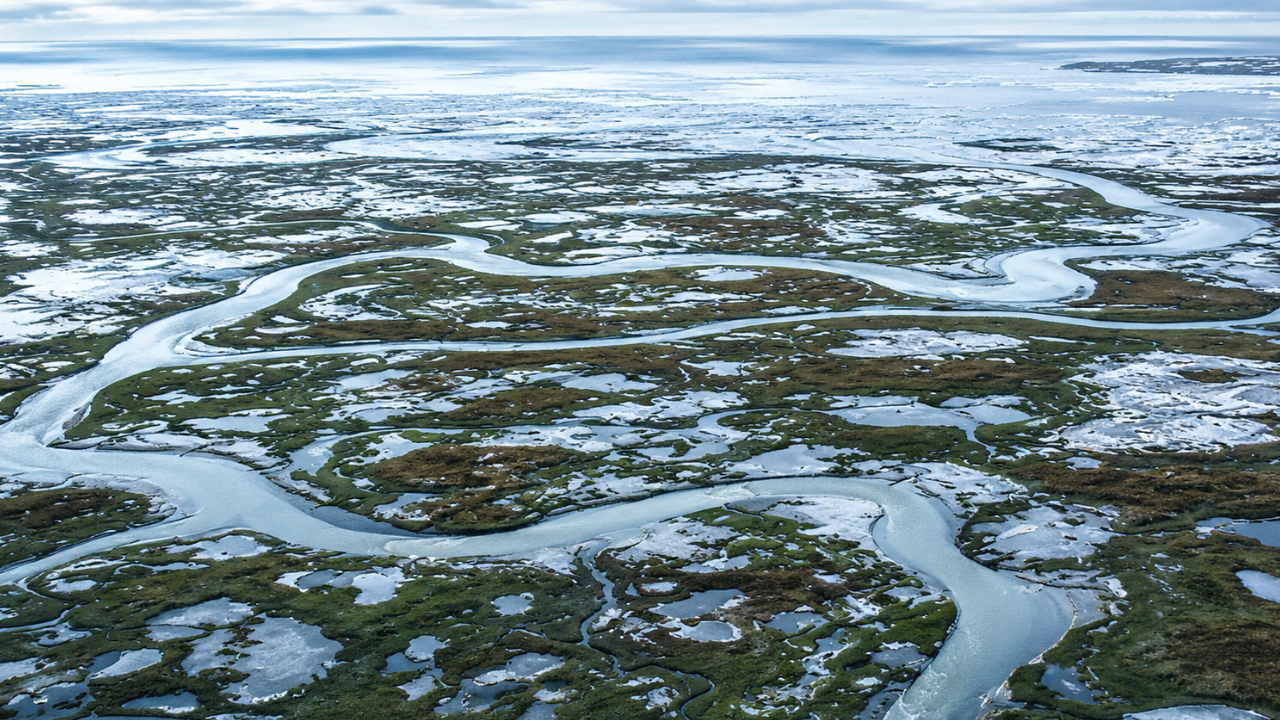
For decades, global climate models treated the far north like a giant environmental safety net. The math seemed comforting. As temperatures rose, the frozen northern soils would thaw and release greenhouse gases, but warmer weather would also cause massive boreal forests and thick shrubs to grow. More plants meant more photosynthesis. For a long time, scientists figured this green surge would absorb enough carbon dioxide to offset the thawing ground. The Arctic, they believed, would remain a net carbon sponge for most of the century.
That comfort just evaporated.
A study published in Science Advances reveals that we have been looking at an incomplete ledger. By failing to account for the deep layers of ancient carbon buried up to 20 meters underground, standard models overshot how long the planet can rely on the north to clean up our mess. The revised timeline shows that northern soils above 30°N will likely flip from absorbing carbon to dumping it directly into the atmosphere by the 2050s.
This isn't a minor tweak to a spreadsheet. It represents a massive acceleration of the global warming loop. It means the planet will lose one of its largest natural carbon stores decades ahead of schedule, changing the math on how fast we must slash emissions.
The Blind Spot in Our Climate Math
To understand why this model upgrade changes everything, look at how scientists previously measured northern soil. Traditional projections looked mostly at the surface layer, usually the top three meters of soil. That is where the immediate action happens each summer as the topsoil thaws and freezes.
The problem is that the deep ground holds a massive reservoir of ancient carbon. For thousands of years, these soils acted as a natural deep freezer, preserving plant and animal matter before it could fully decompose. Because it stayed frozen year-round, microorganisms couldn't eat it. The carbon stayed locked away.
Standard simulations ignored these deep deposits because tracking soil history over tens of thousands of years is incredibly complex. That omission created a false sense of security. It underestimated both the actual size of high-latitude carbon stocks and how deep thawing can penetrate as the Arctic warms up to four times faster than the rest of the globe.
Reconstructing the Lost History of Yedoma and Peatlands
The researchers behind the new study fixed this systemic blind spot by upgrading a prominent land surface model known as ORCHIDEE-MICT. They basically taught the simulation to look backward in time to rebuild the underground profile of the northern hemisphere.
The upgraded system simulates two specific types of deep carbon stores that older models left out.
Ancient Yedoma Deposits
Yedoma is a specific type of wind-blown, ice-rich permafrost that formed during the last ice age, stretching across vast swaths of Siberia, Alaska, and northern Canada. Because it formed during an incredibly cold, dry era, it contains a massive concentration of organic material mixed with massive wedges of pure ice. Yedoma deposits are deep, often reaching depths of 20 meters. When this ice-rich soil thaws, the ground doesn't just warm up; it collapses entirely, exposing deep layers of organic matter to air and microbes very quickly.
Deep Northern Peatlands
Peatlands developed during the Holocene, the milder geological epoch that started around 11,700 years ago. Over thousands of years, dead moss and plants accumulated in waterlogged, low-oxygen conditions, creating thick layers of carbon-rich peat. In many parts of the sub-Arctic, these peat layers extend up to 10 meters beneath the surface. Like Yedoma, they represent a highly concentrated source of organic matter that is ripe for microbial breakdown if the ground warms.
The research team used the updated model to run historical simulations from 1900 to 2014, calibrating it against real-world observations. Then they projected future conditions through the year 2100 under three different socioeconomic pathways, ranging from aggressive climate action to business-as-usual emission rates.
The results were stark across the board. The Arctic stored far more carbon before the industrial era than anyone acknowledged, which means there is vastly more carbon sitting in the chamber today, ready to escape.
The 2050s Flip from Sink to Source
As the updated model plays out, the Arctic's capacity to absorb carbon steadily weakens over the next two decades. The plant growth on the surface simply cannot keep pace with what is happening underneath.
When deep permafrost thaws, microbes that have been dormant for millennia wake up. They begin consuming the newly defrosted organic matter. This biological frenzy releases a steady stream of carbon dioxide and methane.
By the time we hit the 2050s, the lines cross on the graph. The volume of greenhouse gases escaping from the decomposing deep soil permanently overtakes the volume of carbon dioxide absorbed by expanding forests and shrubs. The Arctic effectively switches teams, transforming from a critical climate helper into an active climate amplifier.
Under high-emission scenarios, this shift leads to a net release of up to 32 billion tons of carbon by the end of the century. To put that in perspective, that is roughly equivalent to several years of total global emissions from all human industrial activity combined, all leaking out from a region we thought was helping us breathe.
Opposing Forces and Geological Nuance
In the scientific community, nothing is entirely black and white, and tracking a massive system like the Arctic requires looking at competing variables. While the Science Advances study paints a grim picture of soil decomposition, other recent research introduces fascinating nuance to how the Earth responds to thawing ground.
For example, a study out of Umeå University published in Nature highlights a hidden geological process that might offer a partial buffer. As permafrost degrades, it doesn't just expose organic matter to microbes; it also exposes long-buried mineral and rock layers to water.
When water interacts with these freshly exposed rock surfaces, it triggers a dramatic increase in chemical rock weathering. This specific chemical reaction actually consumes atmospheric carbon dioxide, transforming it into dissolved inorganic forms that wash down rivers rather than escaping into the air.
The Umeå University team found that in areas where permafrost cover has become patchy and discontinuous, this weathering-driven carbon uptake was sometimes large enough to completely offset or even exceed the CO2 emissions coming directly from the local rivers.
However, both teams of scientists offer a major caveat. Geological rock weathering is a slow, localized process. It can mitigate some of the immediate water-based emissions in specific river catchments, but it cannot stop the massive, regional airborne release of gases from deep, dry Yedoma soils collapsing across millions of square miles of tundra. Relying on rock weathering to save us from a permafrost feedback loop is like using a bucket to bail out a leaking ship. It helps, but the hull is still splitting open.
What This Means for Global Climate Policy
The takeaway here is that our current global carbon budgets are built on outdated assumptions. When world leaders negotiate emission targets, they rely on models that assume the Arctic will keep absorbing carbon for decades. If that sponge stops working by the 2050s, our window to prevent catastrophic warming is much narrower than official policies suggest.
We can no longer view the Arctic as a distant, isolated expanse of ice. It is an active participant in the global economy's carbon ledger. If the deep soil releases billions of tons of carbon, human societies will have to cut their own emissions even faster just to keep global temperatures from spiraling out of control.
Next Steps for Climate Action and Research
Fixing our approach to this problem requires immediate, concrete changes in both scientific research and climate policy.
- Mandate Deep-Soil Modeling: Climate policy groups must reject environmental projections that only look at the top three meters of soil. Future global carbon budget allocations must integrate multi-meter deep soil data, specifically accounting for Yedoma and deep peatlands.
- Map High-Risk Tipping Zones: Funding must shift toward pinpointing the exact geographical regions where deep permafrost is thinnest and most vulnerable to rapid collapse, allowing scientists to track real-time emission spikes.
- Accelerate Decarbonization Timelines: Because the natural carbon sponge is degrading faster than expected, localized emission reduction targets for businesses and governments originally set for 2050 need to be pulled forward to account for the incoming loss of the Arctic carbon sink.
The data shows that the Earth's natural systems are running out of storage capacity. The buffer we thought we had is shrinking, and waiting until the 2050s to see if these models are right is a gamble we cannot afford to lose.